
There is one question that separates the agency that closes deals from the one that keeps spinning: "at which club is this athlete a starter?"
Not "at which club would he fit". A starter. Because no club pays a signing fee to bring in a substitute — and no agent wants to put their athlete on a bench for eighteen months.
The answer changes completely from club to club. And it doesn't depend only on the player's quality: it depends on the formation, the style, the age of whoever is already there and when the contracts in that sector expire.
This article shows how to test that systematically, with a concrete example.
The case: a 23-year-old midfielder and three possible destinations
Picture an athlete in your portfolio: midfielder, 23, left-footed, good long passing, good vision, above-average movement off the ball, average defensive work.
On paper, he is "a midfielder". In practice, he is three different players depending on where you put him:
- In a 4-2-3-1, he is the central midfielder behind the striker — he receives between the lines and serves.
- In a 4-3-3, he is one of three in midfield, with more defensive volume and less freedom.
- In a 3-4-1-2, he is the only playmaker between midfield and the two strikers — a role of maximum creative responsibility.
Three roles, three different demands, three different probabilities of success. Offering the same material to all three clubs is betting that luck will sort it out.
Step 1 — Select clubs by their gap, not by their prestige
The agent's instinct is to aim at the bigger club. The right instinct is to aim at the club with the slot.
Criteria that matter more than the size of the club:
- The age of the starter in that position. A starter aged 32+ is a window opening.
- A contract running out. A starter under contract only until the end of the season is a window opening even faster.
- Recurring improvisation. A team that has been fielding a full-back as a centre-back, or a holding midfielder as a playmaker, has a declared hole.
- Style compatibility. A long-passing midfielder in a patient short-possession team is a waste on both sides.
At Gowl, when you create a Pitch you search for the target club and the real squad walks onto the field automatically, with positions and nationalities. You see the direct competition immediately — no need to rebuild the squad by hand.
Step 2 — Build the same player into all three scenarios
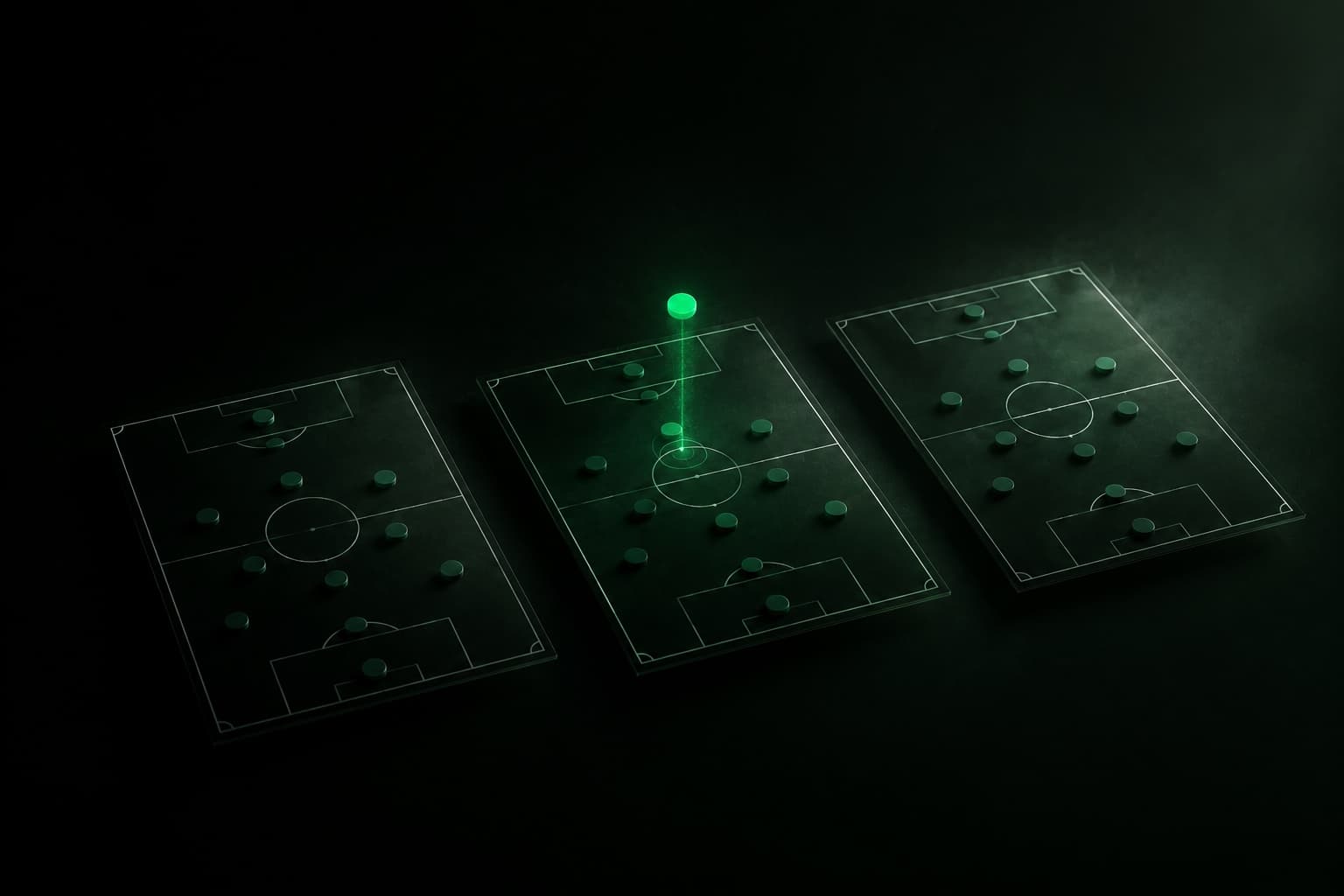
Here is the central exercise. For each club, build a pitch:
Scenario A — A club that plays 4-2-3-1, possession, mid block You position the athlete as the central attacking midfielder (CAM). The zone filter shows who is competing for that slot. In the with-the-ball phase the block pushes up and spreads — the central midfielder ends up in a position to receive between the lines, which is exactly his strength.
Scenario B — A club that plays 4-3-3, counter-attack, high press Same athlete, now as one of three midfielders. The high press demands defensive volume — his weakest point. The board makes that visible before you spend a meeting finding out.
Scenario C — A club that plays 3-4-1-2, direct play, low block He becomes the sole playmaker. Maximum creative responsibility, little defensive cover around him. It may be the best fit of the three — or the riskiest, if the team defends a lot and attacks little.
Each scenario is saved with its own name and a frozen snapshot — formation, phase, styles and the entire line-up are kept. You reopen and rebuild any of them whenever you want.
Step 3 — Switch the phases and see what changes
This is the test most people don't run.
A player doesn't occupy the same position for the whole match. With the ball, the block pushes up and spreads. Without the ball, it drops and compresses. The athlete's real role is the average of those two situations — and sometimes the problem only shows up in one of them.
In the Pitch, switching between with the ball and without the ball repositions the whole team on screen. What you look for:
- With the ball: is he in a zone where he receives and creates? Or is he too far from the play?
- Without the ball: does he become the first man pressing? Does he have cover next to him? Is he isolated in a channel he doesn't protect well?
In scenario B of the example — 4-3-3 with a high press — it is precisely in the without-the-ball phase that the fit falls apart. And it is better to find that out on screen than in the third meeting.
Step 4 — Cross it with the adaptation analysis
Tactical fit is half the answer. The other half is whether the athlete survives the environment.
For each player × club pair, Gowl generates three analyses, each with seven dimensions scored from 0 to 100 and a written comment:
- Tactical — includes
Adaptation to the RoleandFit to the League, which speak directly to what you have just built on the pitch. - Institutional —
Rapport with the Fans,Commitment to the Project,Contractual Maturity. - Sociocultural —
Communication and Language,Climate and Food,Transition Record,Emotional Ties.
It is common for the ranking to flip here. The club that looked like the best tactical fit comes out at 51 on the sociocultural axis — a city with a very different climate, a language the athlete doesn't speak, extremely high-pressure fans for a player who has never left home. And the third-placed club on the tactical axis, at 79 on the sociocultural one, becomes the priority target.
That flip is the product of the work. It shows up on no statistics spreadsheet.
Step 5 — Rank the targets and attack in the right order
With the three scenarios built and the analyses generated, you have a simple matrix:
| Club | Real slot | Tactical fit | Adaptation | Priority |
|---|---|---|---|---|
| Club A | Starter aged 33, contract running out | High | Medium | 1st |
| Club C | Open slot, standout role | High | High | 2nd |
| Club B | Young, settled competition | Medium | Medium | Don't prioritise |
And, more important than the order: you now know what to say to each one. For Club A, the argument is succession. For Club C, it is creative prominence. Different arguments, different dossiers — because the slots are different.
The invisible gain: the athlete stops being offered in the wrong place
Putting a player in a club where he doesn't fit is expensive for everyone. The club loses money, the athlete loses a season of his career and the agency loses reputation — which is the only asset it really has.
Testing the fit before offering is not bureaucracy. It is protecting the athlete and the agency at the same time.
Frequently asked questions
How many clubs is it worth testing per player? There is no technical limit in Gowl. In practice, between 5 and 10 well-chosen targets yield more than 40 random shots — because each one becomes a specific approach.
Is the target club's squad up to date? Yes. The Pitch pulls the squad straight from the international database at the moment you build the board.
Can I compare two scenarios side by side? Each scenario is saved with its own name and snapshot and can be reopened and rebuilt at any time. Today the comparison is made by opening the saved scenarios.
What if the athlete plays well in two positions? Even better — build a pitch for each one. Offering versatility proven on a tactical board is worth far more than writing "versatile" on a card.
Does the analysis change if I change the pitch's formation? The adaptation analysis is generated per player × club pair. The pitch and its tactical report do reflect the specific configuration you built — formation, phase and styles.
In short
"Where does my player fit" is not a question of intuition. It is a test you run: build the athlete into each target's real squad, switch the phases, generate the adaptation analysis and rank.
The result is you arriving at the right club, at the right time, with the right argument.
Test your athlete at as many clubs as you like. Real squads, 12 formations, two tactical phases and an adaptation analysis across 21 dimensions. → Talk to the Gowl team
Read next
- How to pitch a player to a club
- With and without the ball: how to prove your athlete serves the club's model
- From notebook to archive: how to structure your agency's portfolio