

Every director of football gets the same thing. A PDF with the athlete's photo, height, weight, dominant foot, current club, one line of season statistics and a YouTube link with two and a half minutes of highlights.
He gets dozens of those a week. And he answers almost none — not out of ill will, but because that material answers none of the questions he needs to answer in order to take a name to the board.
This article is about what to put in its place.
What the director of football actually needs to know
Before writing any material, it pays to understand the mind of the person receiving it. The director of football is not asking himself "is this player good?". He already assumes so — you wouldn't send a bad one.
He is asking himself four other things:
- Where does he play in my team? Not the generic position. The slot. Which starter he threatens, which substitute he replaces, in which formation.
- Does he serve my coach's model? A winger who lives off one-on-ones solves nothing in a team that plays a low block and direct counter-attacks.
- Can he handle this environment? The pressure from the stands, the language, the climate, the distance from family, the exposure.
- What is the risk of it going wrong? Because his mistake has a first and last name, and it costs a season.
A PDF with statistics partly answers question 1 and nothing of the other three.
The classic mistake: talking about the player instead of talking about the fit
Generic material has a structural problem: it describes the athlete in the abstract. It works for any club — and, for that reason, it convinces none.
Compare the two sentences:
❌ "Attacking midfielder, 23, left-footed, 8 goals and 11 assists on the season. Excellent vision and set pieces."
✅ "In the 4-2-3-1 your team used in 71% of the season's matches, he takes the central midfield slot. The current starter is 33 and under contract until the end of the year. He speaks Spanish and English, holds an EU passport and already played abroad at 20 — the transition record is settled."
The second sentence isn't prettier. It is harder to ignore, because it was written for that club and for no other.
The work of building that second sentence is what this article breaks down.
Step 1 — Start with the club, not with the player
It sounds counterintuitive, but it is the inversion that changes everything: before choosing what to say about your athlete, study the destination squad.
What to gather:
- The formation most used in the season. Not the one the coach says he uses — the one he actually fielded.
- The squad by position. Who starts, who sits, how old each one is, when each contract expires.
- The style with and without the ball. Does the team build short or go long? Does it press high or wait in a mid block?
- Where the real gap is. A sector with only one specialist, an ageing starter, a position the team has been improvising.
At Gowl, this survey is the first step of the Pitch: you search for the target club and the platform brings in the real, up-to-date squad straight from the international database. You don't have to dig it out of a statistics site — it walks onto the field already.
Step 2 — Build the tactical board with your player inside it
Here is the turn. Instead of describing the slot in words, show the slot.
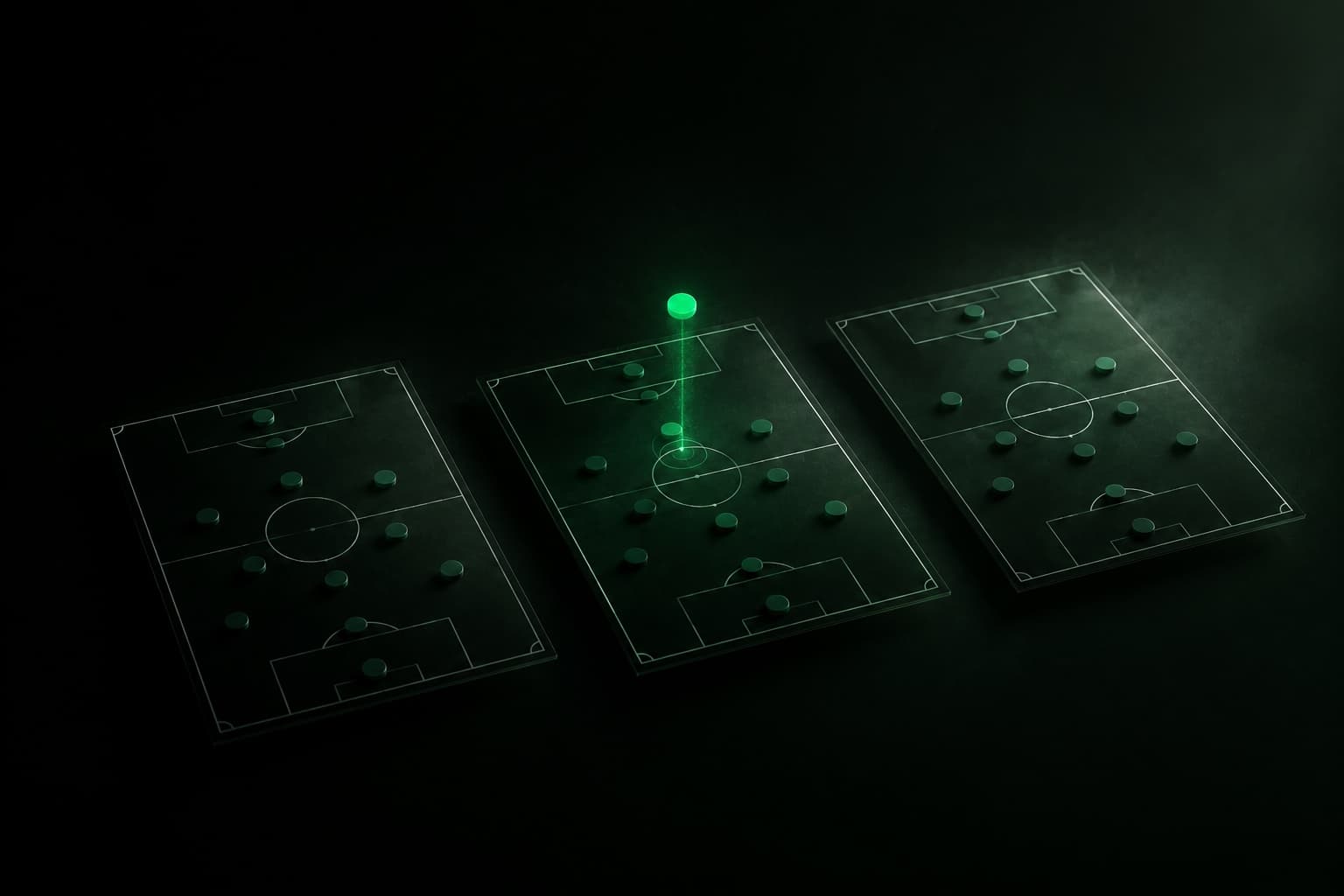
The Pitch is a tactical board where you:
- choose one of 12 formations (4-4-2, 4-3-3, 4-2-3-1, 4-1-4-1, 4-4-1-1, 4-5-1, 4-3-1-2, 3-5-2, 3-4-3, 3-4-1-2, 5-3-2, 5-4-1);
- position the target club's real squad on the field;
- place your athlete in the slot he will compete for, visually highlighted;
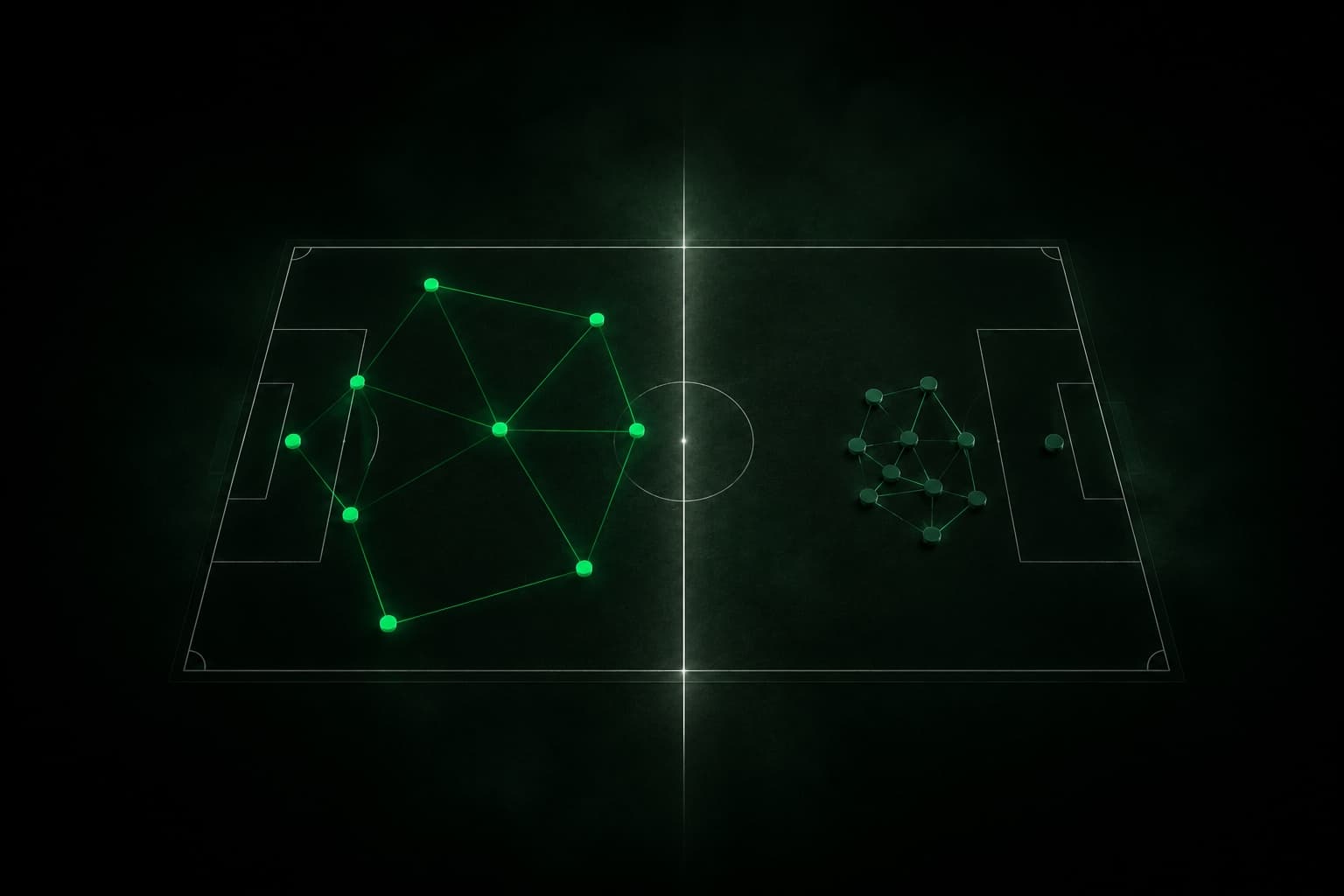
- define the style with the ball (possession, direct play, counter-attack, positional play, attacking down the flanks) and without the ball (high press, low block, mid block, zonal marking, man marking);
- switch between the two tactical phases and watch the whole block reposition itself — pushing up and spreading in attack, compressing and dropping in defence.
The system validates the position: a goalkeeper doesn't end up on the wing, a centre-back doesn't turn into a striker. The field won't let you force it — which, incidentally, protects your credibility.
Why this works: directors of football and coaches read pitches. It is their native language. A board that is set up communicates in three seconds what two paragraphs don't communicate in three minutes.
Step 3 — Build more than one scenario
A common mistake is betting everything on a single reading. If the club doesn't see your athlete in that specific role, the conversation is over.
Build variations and save each one:
- "Fit as a left winger in the 4-3-3"
- "Fit as a second striker in the 3-4-1-2"
- "Fit as a right-sided midfielder in the 4-2-3-1"
Every analysis in Gowl keeps a frozen snapshot of the configuration — formation, phase, styles and the entire line-up. You can reopen and rebuild exactly that scenario months later, or compare the versions side by side before deciding which one goes into the meeting.
This also has a commercial effect: you stop offering "a player" and start offering two or three solutions to different squad problems. It multiplies the ways into the conversation.
Step 4 — Bring the answer on adaptation before they ask
This is where most agencies lose the negotiation, because they simply have nothing to say.
Gowl generates three analyses of the player × target club pair, each with seven dimensions scored from 0 to 100 and a written comment on every dimension:
Tactical Analysis (G270 Method) — Tactical Style, Collective Intelligence, Tactical Rigour, Physical Intensity, Adaptation to the Role, Technical-Tactical Integration, Fit to the League.
Institutional Analysis — Identification with the History, Winning Mentality, Rapport with the Fans, Commitment to the Project, Institutional Representation, Contractual Maturity, Public Image.
Sociocultural Analysis — Openness to Diversity, Climate and Food, Lifestyle, Emotional Ties, Communication and Language, Transition Record, Cultural Adaptation.
Each axis appears on a gauge with a colour scale: green above 80, yellow above 60, orange above 40, red below that.
One strategic detail: don't hide the low score. If the sociocultural axis came out at 58 because the athlete has never lived abroad, take that into the conversation and take the plan with it — family support, language adaptation, time within the window. An agency that only shows green loses credibility on first contact. An agency that names the risk and arrives with mitigation becomes a partner.
Step 5 — Close with a single deliverable
Boards don't decide on WhatsApp. They decide in a meeting, with a document on the table.
Gowl exports to PDF:
- the Pitch report, with the board set up, the line-up and the skills marked;
- the full tactical report, with seven blocks of text: Attack, Defence, Offensive transition, Defensive transition, Style of play, Collective play and Summary;
- the adaptation report, with the scores and the comments by dimension.
And all of it comes out in the language of the conversation — Portuguese, English or Spanish. If the person on the other side is a sporting director in Portugal or Mexico, he gets the material in his own language, with no improvised translation.
The dossier template that works
If you want a ready structure for your next submission:
| Block | Content | Length |
|---|---|---|
| 1. The slot | Which squad gap the athlete solves, with the tactical board set up | 1 visual page |
| 2. The player | Objective card: position, zone, age, contract, value, foot, height | Half a page |
| 3. The tactical fit | 7-block report — how he behaves in both phases | 1 page |
| 4. The adaptation | The three axes, with the scores and the points of concern owned up to | 1 page |
| 5. Documentation | Passport, second nationality, languages spoken | 3 lines |
| 6. The proposal | What you want: trial, loan, purchase, terms | Short and direct |
Six blocks. No more than that. A twenty-page dossier isn't read — it's filed.
The mistake that cancels out all the work
Sending the same dossier to ten clubs.
The work described here is per player × club pair. It is that specificity that makes the material work. The moment you reuse the same PDF and just change the recipient's name, you go back to being the generic PDF — only with more pages.
The good news: at Gowl the heavy work is done once. The athlete's portfolio is registered a single time, with the 32 attributes, the languages, the passport and the notes. What changes from club to club is the pitch and the analysis — and those take minutes, not days.
Frequently asked questions
What is the ideal length of a player dossier? Between 4 and 6 pages. Enough to answer where he plays, whether he serves the model, whether he adapts and what you are proposing. Material longer than that is rarely read to the end.
Should I send the dossier on first contact? No. First contact should be short and point at the specific slot ("I saw you've been improvising at left-back"). The full dossier goes when there is interest — that way it reaches someone who already wants to read it.
Do I need to show the low scores in the analysis? Yes. An experienced director of football distrusts material that only has upside. Naming the risk and arriving with a mitigation plan builds more trust than hiding it.
How do I know the formation the club really uses? From the season's statistics, not from the coach's interview. The most-used formations appear in the data from the international database integrated into Gowl.
Can I build the same player at several clubs? Yes, with no limit. Each player × club pair has its own pitch, its own analysis history and its own averages.
In short
Pitching a player to a club is not describing the player. It is showing the slot, proving the fit and owning the risk before they ask.
Whoever does this isn't competing for attention with the other PDFs in the inbox. They are entering a different conversation.
Build your next dossier in Gowl. Portfolio, tactical pitch with the target club's real squad, adaptation analysis across 21 dimensions and PDF export. → Talk to the Gowl team
Read next
- Where does my player fit? Building the same athlete at three different clubs
- With and without the ball: how to prove your athlete serves the club's model
- Passport, language and adaptation: the data that unlocks a transfer to Europe