
There is one argument no agency can sustain for long in a conversation with a coach: "he's good, he adapts to any system".
Coaches don't believe it because they know it isn't true. The same player who is decisive in a possession team can be irrelevant in a counter-attacking team. The winger who breaks games open one-on-one can be a problem in a system that demands recovery runs all the way back to the byline.
The difference between those scenarios is not in the player. It is in what the team does with the ball and what it does without the ball — and in what each of those phases demands from whoever fills that slot.
The two halves of any match
A team plays in two alternating states. That sounds obvious and it almost never appears in the material circulating in the market.
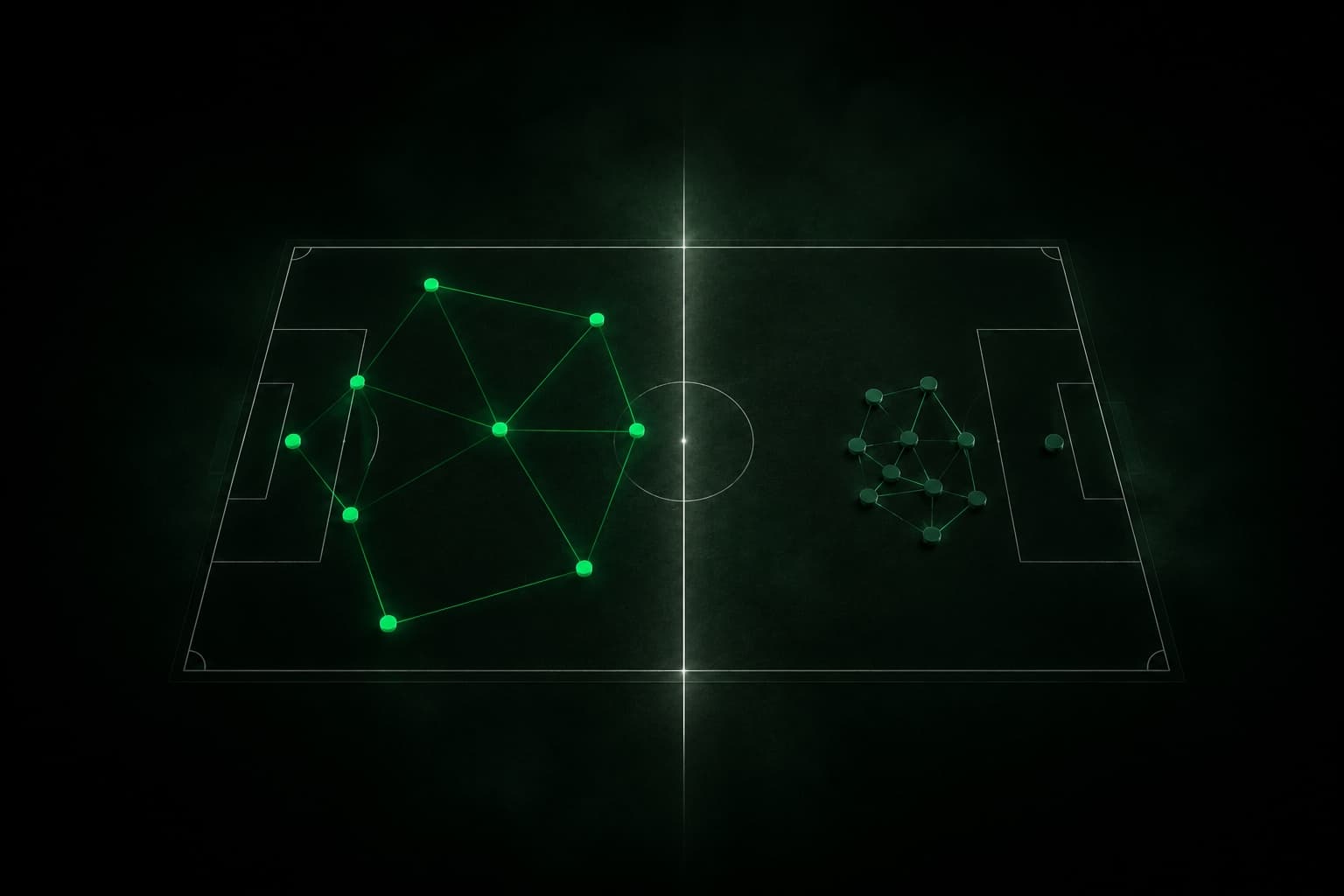
With the ball, the block pushes up, spreads and stretches. The distances between players grow. What is asked for is occupation of space, the ability to receive under pressure, quick decisions and progression.
Without the ball, the block drops, compresses and narrows. The distances shrink. What is asked for is positional discipline, cover, pressing intensity and reading of passing lanes.
The same athlete can be excellent in one phase and a liability in the other. It is precisely that asymmetry the club wants to understand before signing — and the one the agency needs to anticipate.
The ten styles that define what the club is asking for
Before positioning any player, you have to name what the team does. Gowl works with five styles per phase.
With the ball
| Style | What the team does | What it demands from the player |
|---|---|---|
| Possession | Keeps the ball, patient build-up, many passes | First touch, short passing, movement to offer an angle |
| Direct play | Goes vertical fast, few touches, directness | Aerial play, duels, attacking space |
| Counter-attack | Wins the ball and attacks at speed | Pace, decision-making in open field, ball carrying |
| Positional play | Rational occupation of spaces, coordinated rotations | Positional discipline, reading of the game, less improvisation |
| Attacking down the flanks | Builds through the wide areas, crosses, external depth | Crossing, one-on-ones, stamina to repeat runs |
Without the ball
| Style | What the team does | What it demands from the player |
|---|---|---|
| High press | Presses the opponent's build-up in the attacking half | Physical volume, aggression, pressing trigger |
| Low block | Defends compact near its own box | Concentration, defensive aerial play, discipline |
| Mid block | A balance between pressing and dropping | Reading the moment, versatility |
| Zonal marking | The reference is the space | Positioning, communication, line coordination |
| Man marking | The reference is the direct opponent | Individual duels, stamina, controlled aggression |
The combination is what defines the club. A possession + high press team and a direct play + low block team ask for practically opposite players — even though both need "a midfielder".
The test: build the athlete into both phases
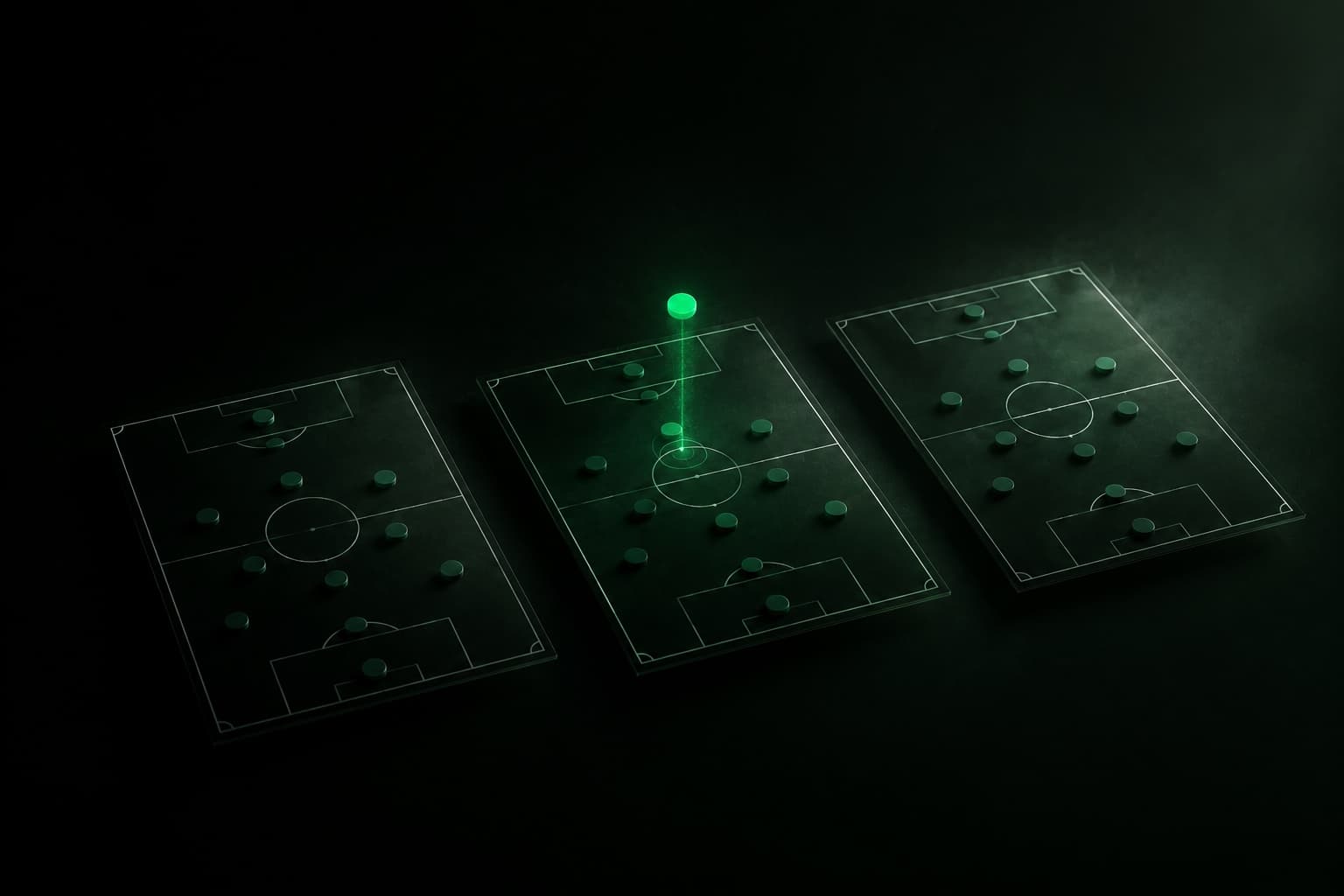
In Gowl's Pitch, you build your player's tactical board inside the target club's real squad and switch between the two phases. The whole team repositions itself on screen: pushing up and spreading in attack, compressing and dropping in defence.
That is where the test happens.
In the with-the-ball phase, look at:
- Is your athlete in a zone where he receives and decides, or is he far from the ball?
- Are there team-mates nearby for the short combinations he does well?
- Does the height of the block favour what he does best — attacking space or receiving between the lines?
In the without-the-ball phase, look at:
- Does he become the first man pressing? Does he have the profile for that?
- Is he isolated in a channel with no cover next to him?
- Does the block compact into a place that demands from him exactly what he doesn't do well?
When the fit falls apart, it is almost always in the second phase. The player who is brilliant with the ball but doesn't sustain the defensive task is the most common case of a frustrated signing — and it is what the club fears most.
What to do when the defensive phase is the problem
Finding the problem is not the end of the conversation. It is the beginning of a better one. Three legitimate routes:
1. Change the role at the same club. Maybe he doesn't work as a winger in a 4-3-3 with a high press, but does work as an inside midfielder in a 4-2-3-1 for the same team. Build the second scenario and compare.
2. Change the target. If the defensive demand of that model is incompatible, there is another club with a mid block and zonal marking where the same athlete performs far better. Better to find out now.
3. Own it and mitigate. Take the weak point into the conversation, with context: "without the ball he is limited in this model, but with the covering midfielder you already have in that sector, the cost drops". That shows you understand football — and an agency that understands football is heard differently.
The tactical report: seven blocks that answer both phases
Once the board is built, Gowl generates a tactical field report with seven blocks of text, written from the configuration you set up:
- Attack — how the athlete behaves in the with-the-ball phase inside that style
- Defence — what he takes on in the without-the-ball phase inside that block
- Offensive transition — what he does in the seconds after winning the ball
- Defensive transition — what he does in the seconds after losing it
- Style of play — the combined reading of the two phases
- Collective play — how he affects the structure and the team-mates around him
- Summary — the conclusion on the fit
Blocks 3 and 4 deserve special attention: transitions are where most matches are decided and where almost no agency material goes. Bringing a written reading of the five seconds after losing possession is the kind of thing that makes a coach pay attention.
Two scenarios, one example
Same striker, two clubs:
Club A — Counter-attack + low block. The team defends near its own box and attacks space. A quick striker who runs in behind the defensive line finds open field all the time. The defensive phase asks little of him: he waits high up, he doesn't track back deep. High fit.
Club B — Possession + high press. The team dominates the ball against deep blocks: there is no space in behind to attack. It requires a striker who plays with his back to goal, receives under pressure and turns. And, without the ball, it requires him to be the first pressing trigger. Low fit — same player, same quality.
Neither club is right or wrong. What exists is compatibility — and it can be demonstrated.
Frequently asked questions
What changes visually when you switch the phase? The positions of every player on the field. In the with-the-ball phase the block pushes up and spreads; in the without-the-ball phase it drops and compresses. The line-up is preserved — only the arrangement changes.
Can I save both scenarios? Yes. Each analysis keeps a frozen snapshot with formation, phase, styles and line-up, and can be rebuilt later.
Do I need to know the target club's exact style? It helps a lot, but you can test hypotheses. Build it with the style the team appears to use and compare with a variation. The most-used formations of the season, available in the data from the integrated database, are a good starting point.
Do the two phases use different formations? The same formations apply to both phases — what changes is the arrangement of the block. There are 12 formations available.
Does this replace video analysis? No. Video shows what happened; the pitch shows the structural fit in the slot. They are complementary layers, and the strongest dossier uses both.
In short
"He adapts to any system" convinces nobody who understands football. What convinces is showing the athlete positioned in the real squad, in both phases of the game, inside the style that club actually practises.
When the defensive phase exposes a limit, that doesn't weaken the offer — as long as you arrive with the limit mapped and the mitigation thought through. That is the difference between selling a player and discussing a solution.
Build your athlete into both phases. 12 formations, 10 styles of play, the target club's real squad and a tactical report in seven blocks. → Talk to the Gowl team
Read next
- Where does my player fit? Testing the same athlete at three different clubs
- How to pitch a player to a club
- From notebook to archive: how to structure your agency's portfolio